

Blog
Solving “Awkward Space” Problems, Sizes and Measurements of sofa…
Have you ever fallen in love with a sofa in a showroom, only to bring it home and realize it overwhelms your living room? Or perhaps you have a pesky building pillar that forces your furniture into the center of the room, wasting valuable floor space?
Most homeowners assume that if a room is an odd shape, they have to sacrifice comfort or style. But the truth is, standard furniture is designed for standard rooms—and very few homes are actually "standard." Whether you are dealing with tight corners, interfering columns, or just a compact layout, the solution isn’t finding a smaller sofa; it’s finding a smarter one.
In this guide, we will walk you through how to tackle awkward spaces and, most importantly, how to take the exact measurements needed to order a custom 3-seater or L-shaped sofa that fits your home like a glove.
The "Awkward Space" Challenge
Every home has that one area that is difficult to furnish. In mass production, sofas are built to fixed dimensions (usually 6ft or 7ft lengths). When you try to force these fixed rectangles into irregular rooms, you run into several problems:
- The Pillar Problem: Many modern apartments have structural columns protruding from the walls. A standard sofa leaves a massive "dead gap" behind it
- because it cannot sit flush against the wall. A custom manufacturer can design a "notch" or cut-out in the sofa frame to wrap around the pillar perfectly.
- The Doorway Block: If your wall is 8 feet long, but a standard 7-foot sofa looks too small and an 8-foot sofa blocks the doorway, you are stuck. Custom sizing allows you to build a 7-foot 8-inch sofa that maximizes seating without blocking traffic.
- Visual Weight: In small rooms, a sofa with standard deep arms can make the space feel claustrophobic. Customizing the depth (making it 32 inches instead of the standard 36 inches) can save vital walking space without sacrificing comfort.
How to Measure for a Custom 3-Seater Sofa
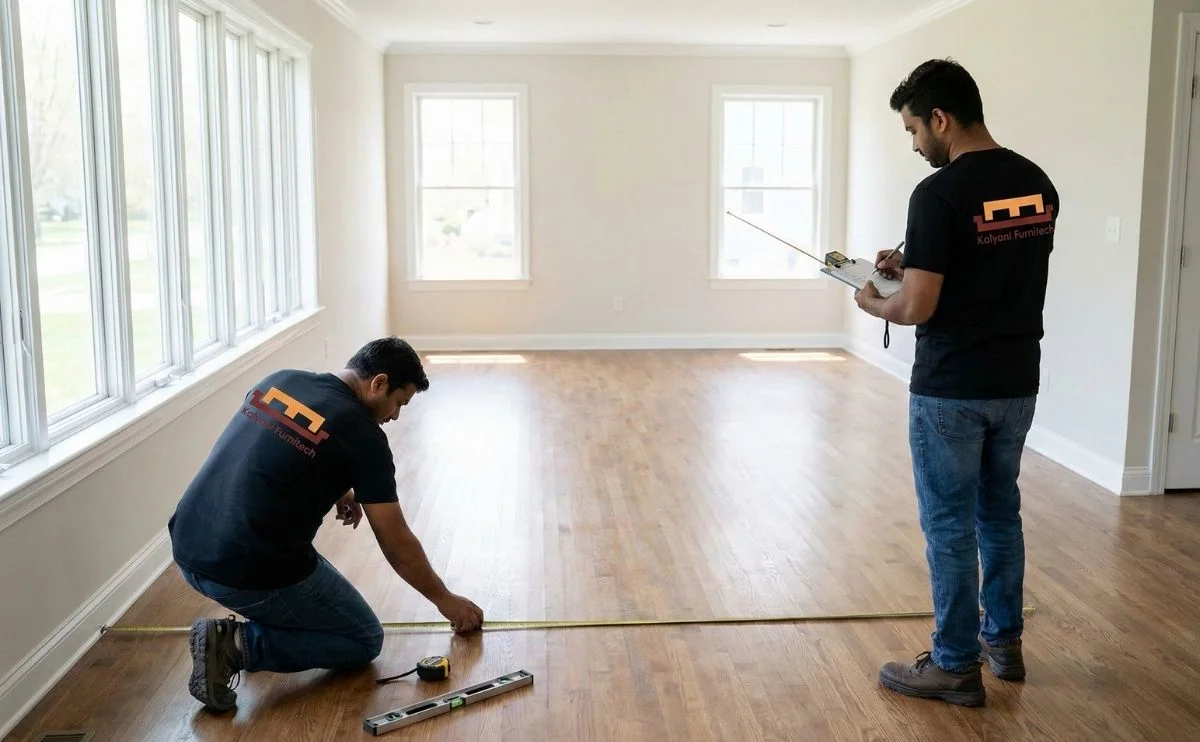
Ordering a linear (straight) sofa is the easiest starting point, but "eye-balling" it is a recipe for disaster. Here is exactly what you need to measure:
- 1. The "Wall" Length (Outer-to-Outer): Measure the wall where the sofa will go. However, do not just measure the wall; account for side tables. If you have a 10-foot wall and want two side tables (1.5 feet each), your custom sofa length should be exactly 7 feet.
- 2. The Depth (Front-to-Back): This is where most people make mistakes. Measure from the wall outwards. Ensure you have at least 18 to 24 inches of clearance between the front of the sofa and your coffee table. If your room is narrow, request a "sleek depth" design.
- 3. The Height: If you are placing the sofa in front of a window, measure the distance from the floor to the window sill. Your sofa back should ideally not block the window view.
How to Measure for an L-Shape or Corner Sofa
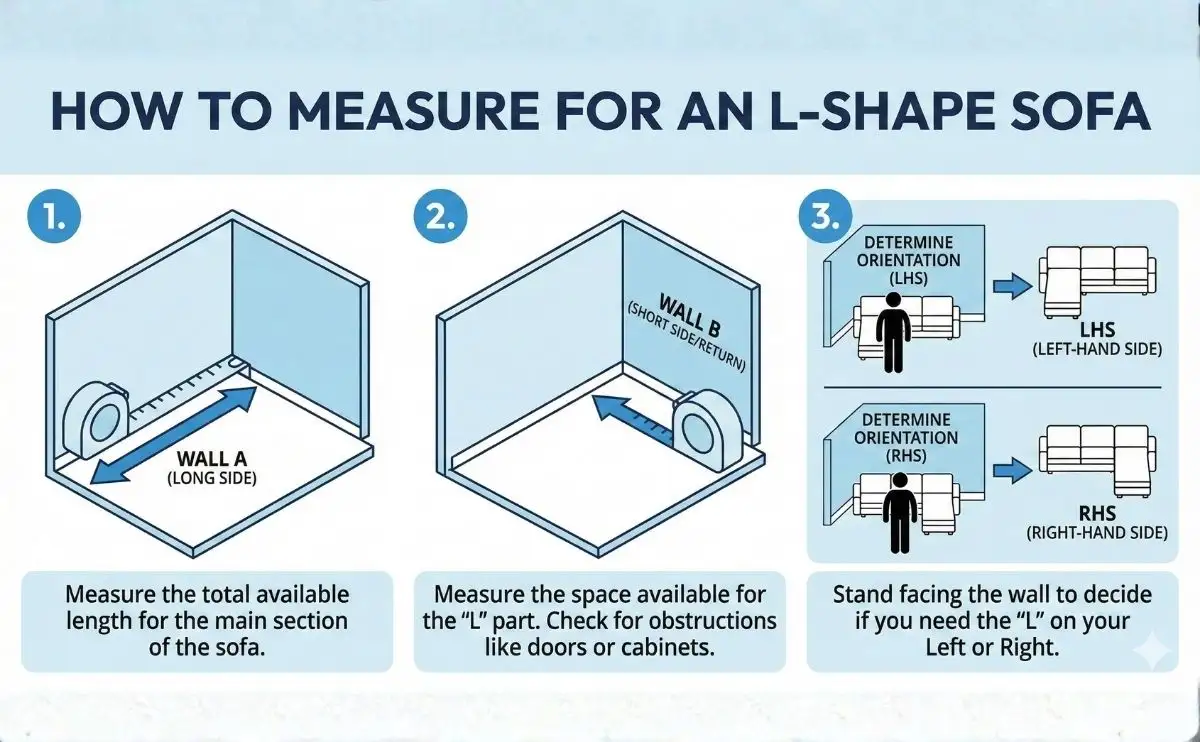
Corner sofas are the kings of comfort, but they are tricky to measure because they have two different lengths and an orientation.
- 1. Measure Wall A (The Long Side): Measure the total available length for the main section of the sofa.
- 2. Measure Wall B (The Short Side/Return): Measure the space available for the "L" part. Be careful: ensure the L-part does not extend so far that it blocks the entry to the room or hits a TV cabinet.
- 3. Determine Orientation (LHS vs. RHS): Stand in front of the spot where the sofa will go, facing the wall.
- If you want the L-extension on your Left, you need a Left-Hand Side (LHS) sofa.
- If you want it on your Right, you need a Right-Hand Side (RHS) sofa.
- 4. The Diagonal Entry: Before you order, measure the width of your main door, elevator, and stairwell. Large L-shaped sofas are often made in two pieces to ensure they can be delivered into your home.
Summary
Your home shouldn't have to change to fit your furniture; your furniture should be built to fit your home. By identifying "awkward" zones—like pillars or tight angles—and taking precise measurements of your length, depth, and orientation, you can unlock the full potential of your living room.
A custom-made sofa eliminates the gap between "what fits" and "what looks good," turning even the most difficult corner of your house into your favorite spot to relax.